Hi there, welcome to my personal website!

My Name Is

Kofi Addo Annan.

My Skill Set

I have very good organizational and time management skills. My greatest strength is my ability to effectively handle multiple projects resulting in timely completions.

Coding

I have a very good coding background. I have research experience in machine learning models for forecast-informed decision making. I am also interested in large language models (LLMs) architectures and their adaptation for time-series problems. I am proficient in Python and C.

Simulation Tools

During my time as an undergraduate student while pursuing Electrical/Electronic Engineering, I gained knowledge in Power System Simulation. Consequently, the Electronics courses in the Electrical/Electronic Engineering curriculum allowed me perform some simulations in circuits as well. During my studies at the master's level, I used MATLAB for load flow analysis using methods like Gauss-Seidel, Newton-Raphson and Backward-Forward Sweep iterations. Simulation Softwares include: Totally Integrated Automation Portal(TIA Portal), MATLAB, Multisim and LT Spice.

Hardware Implementation

During my final year as an undergraduate student researcher, I had the opportunity to work in a group of three(3) students where we designed and implemented an automated traffic light system which is optimized to control emergency situations on our Ghanaian roads to ease congestion and faster response times. My interest in emerging transportation electrification technologies had me working on several design projects in dc-dc converter design, automatic inductive charging and battery management systems. Skill: Soldering circuit and PCB Designs

Presentation and Writing

My educational background and work experiences has enhanced my presentation and writing skills. Major skills include: Preparing informative and comprehensible presentations or writing. Public speaking.
Projects

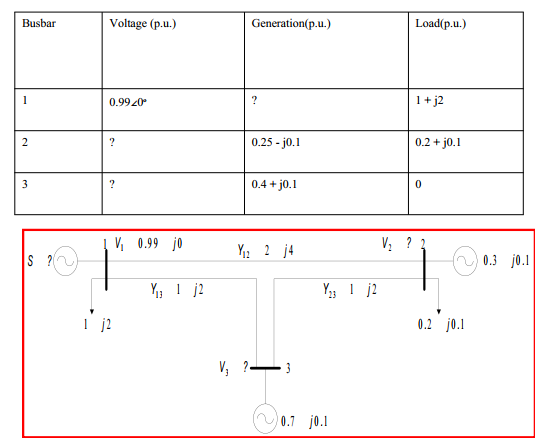
Gauss-Seidel Iteration of a 3-bus System

Project Description

For a three bus system, the Gauss-Seidel iterative method is used to obtain bus 2 and bus 3 voltages respectively. Also, the slack bus power, line flows and line losses are calculated using a tolerance of 0.001 for both real and imaginary parts of the voltages.

Download code
img

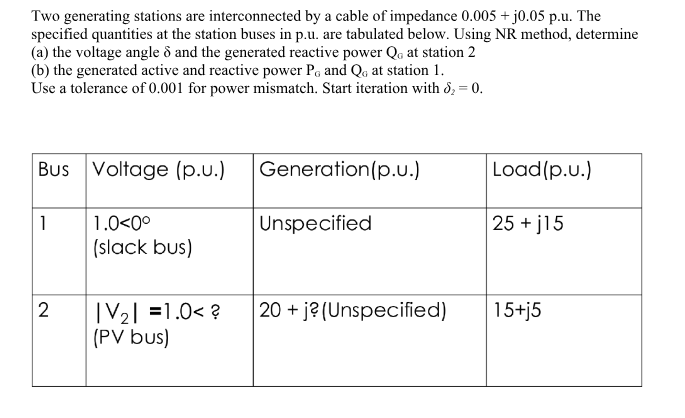
Newton-Raphson Iteration of a 2-bus Network

Project Description

For two generating stations interconnected by a cable of impedance 0.005 + j0.05 p.u. The specified quantities at the station buses in p.u. are: Bus 1 voltage (Slack bus): 1.0< 0 degress in p.u Bus 1 generation: unspecified Bus 1 load: 25 + j15 in p.u Bus 2 voltage: 1.0 < ? in p.u Bus 2 generation: 20 + j? (unspecified) Bus 2 load: 15 + j5 in p.u

Download code
img

Data Cleaning and exploration of Fifa Dataset Downloaded from Kaggle

Project Description

Performed data cleaning and exploration using libraries such as pandas, matplotlib and seaborn on fifa dataset downloaded from kaggle.com for building a linear regression model.

Download Code Download Dataset

Linear Regression Model Using Two-Predictors Based on the Fifa Dataset from Kaggle

Project Description

The predictors "Overall" and "Wage" of the dataset was used to predict player "Potential" due to how well the columns were correlated. The model achieved an R2 score of 0.45 and a root mean squared error of 4.51.

Download code Download Dataset

Logistic Regression to Classify Tumours as Malignant or Benign

Project Description

The "Diagnosis" column indicating either the tumour is "Malignant M" or "Benign B" was encoded using the LabelEncoder library from sklearn.preprocessing to "Benign - 0" and "Malignant - 1". "Diagnosis" column was the target and the rest of the dataset columns were predictors. The model achieved an accuracy of 0.956 and a root mean squared error of 0.209.

Download code Download Dataset

K-Nearest Neighbor (KNN) to Classify Tumours as Malignant or Benign

Project Description

The "Diagnosis" column indicating either the tumour is "Malignant M" or "Benign B" was encoded using the LabelEncoder library from sklearn.preprocessing to "Benign - 0" and "Malignant - 1". "Diagnosis" column was the target and the rest of the dataset columns were predictors. The KNN model achieved an accuracy of 78.94 after using the elbow method to obtain the optimal K value.

Download code Download Dataset

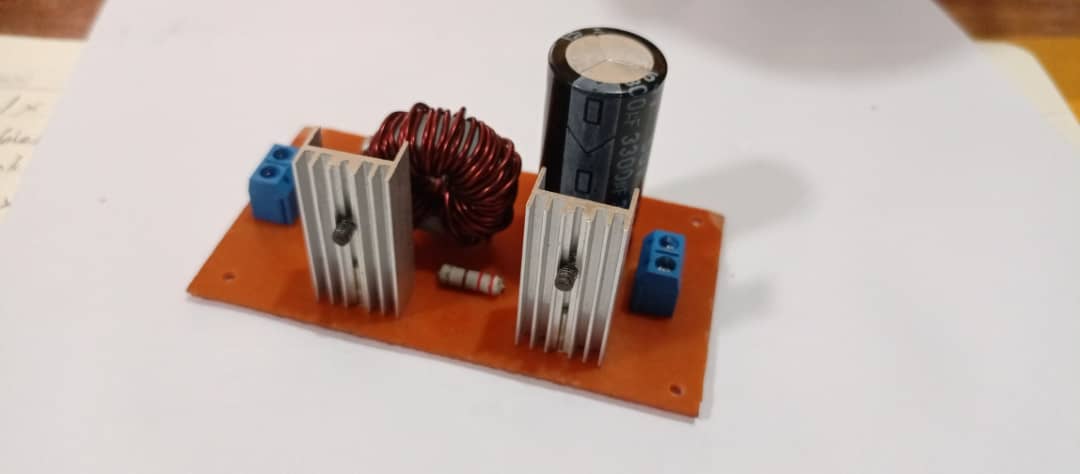
Design and Testing of a 3.7V to 30V DC-DC Boost Converter for Two 12V Cooling Fans Connected in Series.

Project Description

The two (2) TIP41C NPN transistors are used for switching in the converter circuit. The 18650 battery outputs about 2-3 amps to the base of the TIP41 transistors. The current begins to flow from the base to the emitter until the transistor is ‘ON’. The ‘ON’ and ‘OFF’ operation of the TIP41 transistors causes current to flow through the 24-0-24 toroidal inductor. At this point, the inductor stores energy in its magnetic field. When the TIP41 transistor is in its ‘OFF’ state, there is a sudden drop of the inductor current and this change in inductor current produces a back emf in addition to the supply voltage which forward bias the 1N5400 diode and charges up the 3300µF capacitor minus a small voltage drop across the 1N5400 diode. This voltage is supplied to the two (2) 12V cooling fans connected in series. The 3300µF capacitor is recharged each time the transistors are ‘OFF’ thus maintaining a steady output voltage across the loads.

Download Project
img

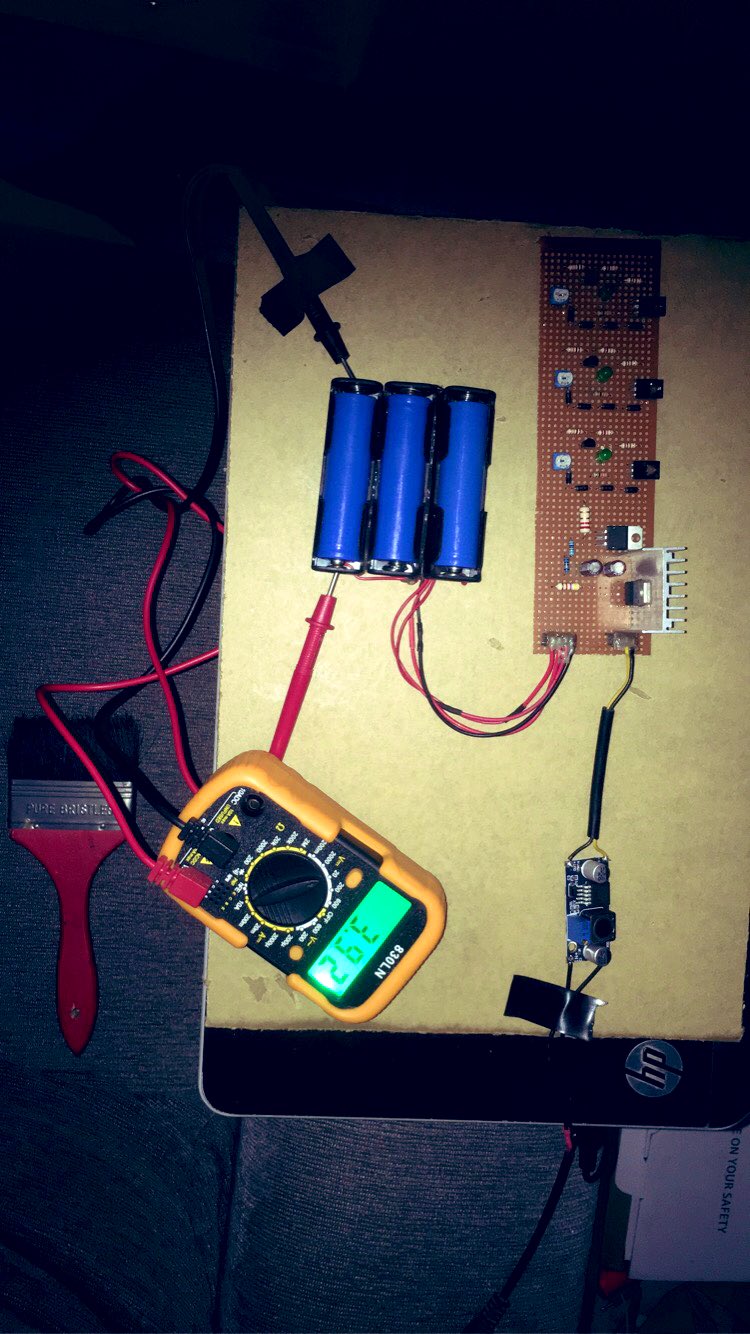
Design and Implementation of a Cost Effective, Less Efficient, Non-Smart Wired Battery Management System Which is Capable of Charging a 3S Battery Pack, Protect it From Overvoltage, Balance The Batteries, and Limit The Charging Current.

Project Description

A basic prototype of a wired battery management system is built which performs the following functions; Charge the lithium-ion battery, limit the charging current, and perform battery balancing. The lithium-ion battery usually has a nominal voltage of 3.7V and about 4.2V when fully charged. This wired battery management system is designed to charge a 3S battery pack of lithium-ion cells individually having different internal structures. Thus, one cell will charge faster than the other due to different discharge rates or internal resistances. The BD140 transistor is connected in series with the four (4) 1N4007 diodes. A TL431 zener reference diode is connected to the base of the transistor. This connection is purposely for the TL431 zener reference diode to open at a voltage value which is 4.2V when the lithium-ion battery is fully charged. At this instance, when the BD140 transistor is active, the charging current will bypass the battery and go through the four (4) 1N4007 diodes connected in series with the transistor. This power will be wasted on the diodes hence the circuit is less efficient. Also, this charging current will light up the LED to indicate full charge. The reference pin of the TL431 zener is connected to the 20k potentiometer hence by adjusting the potentiometer value to the 4.2V, the charging process stops at that voltage value. By this process, passive cell balancing is achieved while charging the 3S battery pack.

Download Project
img

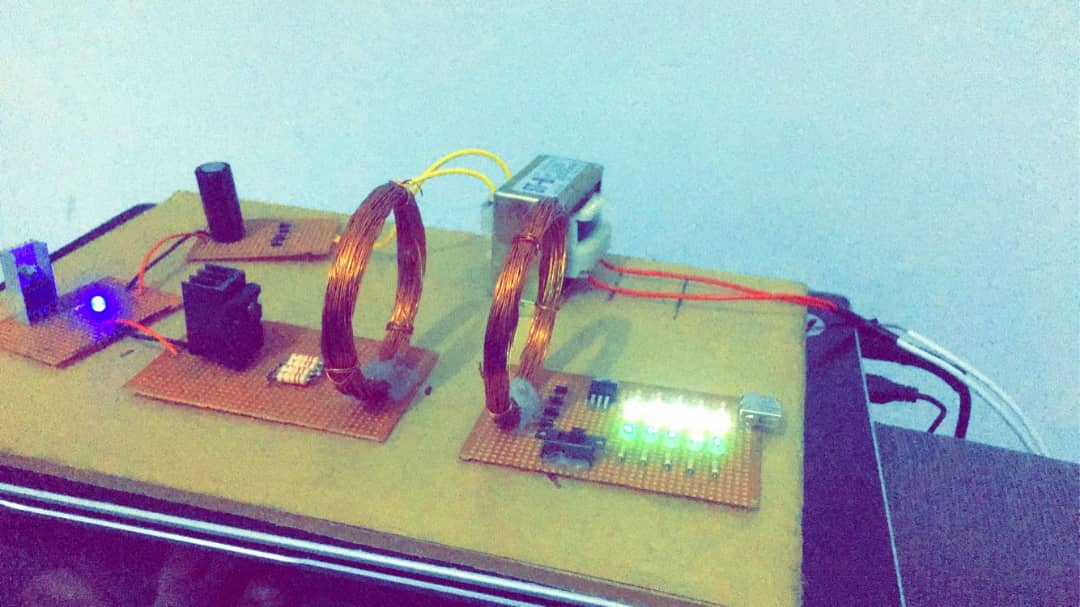
Design and Implementation of a Cost Effective Wireless Power Transfer Circuit That Supplies Power to Multiple Loads.

Project Description

A prototype of a wireless power transmission system which works under the principle of electromagnetic mutual induction is built. A 230VAC is stepped down by the 220V/12V transformer. This 12VAC is fed to the full bridge rectifier circuit. Here, the AC voltage is converted to a pulsating DC voltage by the four 1n4007 diodes and the 2200uF capacitor. The rippled output of the rectifier is smoothened by the 2200uF capacitor into a more DC output voltage. A 12V voltage regulator is used to maintain a constant voltage. Also, there is an led used as an indicator to show that the circuit functions properly. The TTC5200 transistor generates a high frequency AC current across the coil thus creating a magnetic field around it. This magnetic field is transferred to the coil at the receiver side by the Faraday’s law of induction. Another rectifier circuit is installed at the receiver side to ensure the AC voltage is converted to DC. The EMF generated is used to light the LEDs and power the USB charger by the help of 5V voltage regulator. A 2-way switch is used to switch between the two loads.

Download Project
img

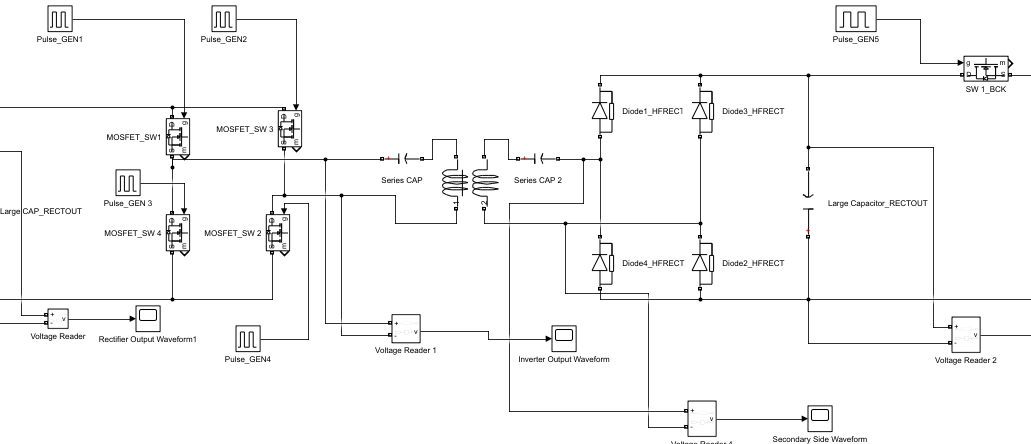
Study and Analysis of Power Electronic Converter Circuits and Wave-forms in a Series-Series Compensated Wireless Power Transfer for Charging Electric Vehicle Batteries using MATLAB Simulink

Project Abstract

For the past two decades, the world has experienced a paradigm shift towards renewable sources of energy such as the solar power, wind, and the hydro power. Our pursuit for cleaner energies is the major reason electric vehicles are being fully realized on our roads today. For another reason, electric vehicles are moreefficient than the conventional combustion engine cars. Electric vehicles on our roads today have three charging modes; conductive charging (AC/DC), wireless charging and battery swap. All these methods are realizable but have their advantages and disadvantages. Wireless charging of electric vehicles stands out in terms of efficiency, charging time, reliability, low volume, reduced cost and weight. Again, with the major deployment of autonomous driving of electric vehicles, robot taxis will be realizable within the next 3 to 5 years. The only charging mode that can be thought of when the taxis are to take power snacks is the wireless charging mode. The main purpose of this paper is to review the power electronic circuitry of the wireless chargers which consists of several power converter types and their voltage waveforms at each conversion stage. The seriesseries compensation topology is employed in this study

Download Project Simulink Model
img

Publications

Design and Implementation of Emergency Traffic Light Preemption System Using PLC Automation.

Abstract

As traffic on the urban Ghanaian road network increases, congestion and delays are becoming more severe. Traffic signals are the most common method by which right of way is dynamically allocated to conflicting movements. Ghanaian traffic light control system is mainly designed by using devices such as timers, relays etc. The critical timing operation is required to be carried out under the existence of heavy traffic situations. This does not give this conventional traffic light control system the flexibility to control throughput to favor emergency vehicles. This conventional practice leads to many problems and subsequent delay for a long time. With the help of a PLC, the requirement of fast automation and effective optimization of traffic light control even in times of emergency can be achieved. At intersections, capacity bottlenecks are formed in urban road networks because at these locations, capacity must be shared by competing traffic movements. For this reason, this thesis introduces an execution and implementation of T-junction emergency traffic control system using SEIMENS S7-200 PLC. Programming in PLC is written in ladder logic with the help of STEP7 MICROWIN software.

Download Paper
img

About Me

Open to work

Thinks and approaches problems critically through methods of academic research, data collection and optimization. Gained good communication skills, organizational skills, and effective time management skills through my pronounced work experiences as a Teaching Assistant, Research Assistant and Project Engineer. My areas of interest include power electronics, power systems optimization, metaheuristic optimization algorithms, machine learning and deep learning.

Download CV

Contact Info

Phone

+233 20 420 3405

Email

annanpap3@gmail.com

Address

Celebrity Hills Avenue, Sakumono.

Accra, Ghana.